
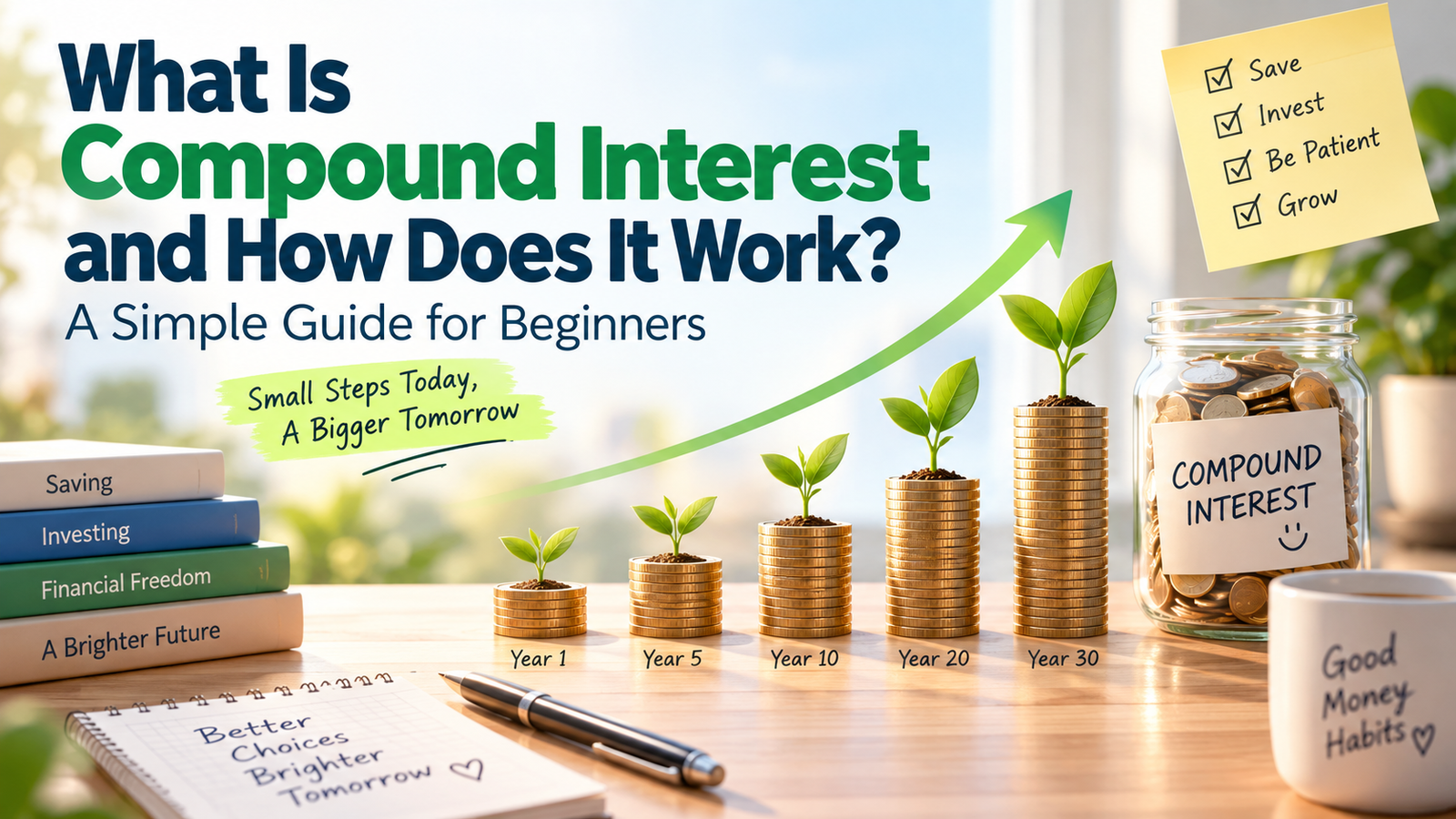
Compound interest is one of the most important ideas in personal finance. It can help savings and investments grow over time, but it can also make debt more expensive when interest is added to an outstanding balance.
The basic idea is surprisingly simple: instead of earning interest only on the money you originally deposited, you may also earn interest on interest that has already been added.
That means time can become an important part of the equation.
In this beginner-friendly guide, we’ll explain what compound interest is, how it differs from simple interest, how the formula works, and what compounding can look like with real numbers.
What Is Compound Interest?
Compound interest is interest calculated on both the original principal and previously accumulated interest.
Suppose you deposit $10,000 into an account earning 5% annually.
After one year, assuming annual compounding and no withdrawals or additional deposits, the balance would be:
$10,000 × 1.05 = $10,500
During the second year, the 5% return is calculated on $10,500 rather than the original $10,000.
That produces:
$10,500 × 1.05 = $11,025
The extra $25 compared with earning $500 each year comes from earning interest on the previous year’s interest.
At first, that difference may look small. Over longer periods, however, repeated compounding can create a much larger gap.
Simple Interest vs. Compound Interest
The easiest way to understand compound interest is to compare it with simple interest.
Simple interest is generally calculated only on the original principal.
If $10,000 earns 5% simple interest each year, the annual interest would remain $500.
After 10 years:
$10,000 + ($500 × 10) = $15,000
With 5% annual compound interest, however:
$10,000 × (1.05)^10 ≈ $16,288.95
That is approximately $1,288.95 more than the simple-interest example.
The difference becomes increasingly noticeable as the time period gets longer.
What Is the Compound Interest Formula?
A common compound interest formula is:
A = P(1 + r/n)^(nt)
Where:
A = final amount
P = principal, or starting amount
r = annual interest rate expressed as a decimal
n = number of times interest is compounded per year
t = number of years
For example, suppose you invest $10,000 at an annual rate of 5%, compounded monthly, for 10 years.
The calculation is:
A = 10,000(1 + 0.05/12)^(12×10)
The result is approximately:
$16,470.09
This is slightly higher than the approximately $16,288.95 produced by annual compounding at the same nominal annual rate.
Why? Interest is being added more frequently.
How Often Can Interest Be Compounded?
Financial products can use different compounding schedules.
Common examples include:
· Annually — once per year
· Semiannually — twice per year
· Quarterly — four times per year
· Monthly — 12 times per year
· Daily — typically 365 times per year
All else being equal, more frequent compounding generally produces a slightly higher effective return for a saver.
However, the stated annual rate, fees, account terms, taxes, and other conditions can matter more than the difference between two compounding schedules.
When comparing financial products, it is therefore important to look beyond the word “compounding” and review the actual APY, APR, or equivalent disclosure applicable to the product.
How Much Can $10,000 Grow?
Consider a simplified example in which $10,000 earns 5% annually with annual compounding and no additional contributions, withdrawals, fees, or taxes.
After 1 year: $10,500
After 5 years: approximately $12,762.82
After 10 years: approximately $16,288.95
After 20 years: approximately $26,532.98
After 30 years: approximately $43,219.42
The starting principal has not changed, and the assumed annual rate remains 5%.
What changes is time.
This illustrates why discussions about compound growth often emphasize starting early rather than focusing only on finding a higher return.
Why Does Time Matter So Much?
Compound growth is nonlinear.
In the early years, most of the balance consists of the original principal. As accumulated gains become larger, those gains can themselves generate additional gains.
For example, with $10,000 growing at 5% annually:
The first year adds $500.
By year 20, a 5% increase on the previous year’s balance is much larger because the balance itself has grown.
This does not mean investment returns are guaranteed. Real investments can rise or fall, and returns are rarely identical every year.
The example simply demonstrates the mathematics of compounding when a constant positive rate is assumed.
What Happens If You Add Money Every Month?
Compound interest becomes even more interesting when regular contributions are included.
Suppose someone starts with $10,000 and contributes another $200 at the end of every month.
If the account hypothetically earns a 5% nominal annual rate compounded monthly for 20 years, the final balance would be roughly $111,000, depending on the exact timing of contributions and calculation method.
The person would have contributed:
Initial deposit: $10,000
Monthly contributions: $200 × 240 months = $48,000
Total contributed: $58,000
The remainder in this simplified example would come from growth.
Regular contributions can therefore matter just as much as the initial deposit.
Compound Interest and Investing
Compound growth is frequently discussed in connection with long-term investing.
The concept can apply when returns remain invested instead of being withdrawn.
For example, an investment may produce dividends, interest, or capital gains. If those returns are reinvested, they can potentially contribute to future growth.
But there is an important distinction.
A savings account may offer a stated interest rate, while stocks and many other investments do not provide a guaranteed annual return.
Using a fixed 5%, 7%, or 10% rate in an investment calculator is a projection, not a promise.
Actual market returns can vary significantly from year to year, and investors can lose money.
Compound Interest Can Work Against You Too
Compounding is not always beneficial.
It can also increase the cost of debt.
Depending on the terms of a credit card, loan, or other borrowing product, interest may accrue on an outstanding balance. If the balance is not reduced, interest costs can make repayment more difficult.
This is why understanding the interest rate alone is not enough.
Borrowers should also examine:
· APR
· compounding or accrual method
· fees
· payment schedule
· minimum payment requirements
· promotional rate expiration dates
The same mathematical principle that can help savings grow can make debt grow as well.
What Is the Rule of 72?
The Rule of 72 is a quick mental shortcut for estimating how long it might take money to double at a constant annual rate.
Divide 72 by the assumed annual rate.
For example:
72 ÷ 6 = 12
At a hypothetical 6% annual return, money would take roughly 12 years to double.
At 8%:
72 ÷ 8 = 9
The estimate would be roughly nine years.
The Rule of 72 is only an approximation, but it can be useful for quickly understanding the relationship between return and time.
What Factors Affect Compound Growth?
Several variables determine the final result.
The most important are:
1. Starting principal — A larger initial amount generally produces more dollar growth at the same percentage rate.
2. Interest or return rate — Higher rates can dramatically change long-term results, although higher expected investment returns often come with greater risk.
3. Time — More compounding periods give growth more opportunity to accumulate.
4. Compounding frequency — Monthly or daily compounding may produce somewhat different results from annual compounding when the nominal rate is otherwise the same.
5. Additional contributions — Regular deposits can substantially increase the final balance.
6. Withdrawals, fees, and taxes — Money removed from an account no longer compounds there, while fees and taxes can reduce the amount available for future growth.
A Common Compound Interest Mistake
One common mistake is assuming that a high hypothetical annual return will continue consistently for decades.
For example, a calculator might show an impressive result using a constant 10% annual return for 30 years.
Mathematically, the calculation can be correct.
Financially, however, the assumption may not reflect what actually happens.
Investment markets fluctuate. Inflation changes purchasing power. Taxes and fees may apply. Individual investors may also make deposits or withdrawals at different times.
Compound-interest calculators are therefore best viewed as planning tools rather than predictions.
Is Compound Interest Better When You Start Early?
Under the same positive rate assumptions, starting earlier generally gives money more time to compound.
Imagine two hypothetical savers who each invest the same amount at the same rate.
One starts at age 25.
The other starts at age 35.
Even if both eventually contribute substantial amounts, the earlier saver has an additional decade during which previously accumulated returns may generate further returns.
This is the mathematical advantage of time.
It does not guarantee a particular investment outcome, but it explains why long time horizons are so powerful in compound-growth examples.
Frequently Asked Questions
Is compound interest guaranteed?
No. A deposit account may pay interest according to its stated terms, subject to changes and applicable conditions. Investment returns, however, are generally not guaranteed and may be negative.
Is monthly compounding better than annual compounding?
If the nominal annual rate and all other terms are identical, more frequent compounding generally results in a slightly higher effective yield. In real financial products, however, rates, fees, and other terms may differ.
Can compound interest make you rich?
Compound growth can be powerful over long periods, but the outcome depends on the amount invested, rate of return, time, contributions, taxes, fees, inflation, and risk. It is not a guaranteed path to wealth.
What is the difference between APR and APY?
APR generally expresses an annualized rate without representing the effect of compounding in the same way APY does. APY reflects the effect of compounding over a year. Exact definitions and disclosure rules can vary by financial product and jurisdiction.
Does compound interest apply to debt?
It can. The way interest is calculated depends on the specific credit agreement. Always review the terms of a loan or credit account rather than assuming every debt compounds in the same way.
The Bottom Line
Compound interest means that interest or returns can begin generating additional interest or returns.
Its long-term effect is driven by a few basic variables: the starting amount, rate, compounding frequency, additional contributions, and—most importantly—time.
The mathematics is straightforward, but the practical lesson is useful: small differences can become much larger when they are repeated over many years.
When using compound-interest calculations for financial planning, remember that examples based on fixed rates are illustrations. Real-world results may be affected by changing rates, market performance, inflation, taxes, fees, and individual circumstances.